
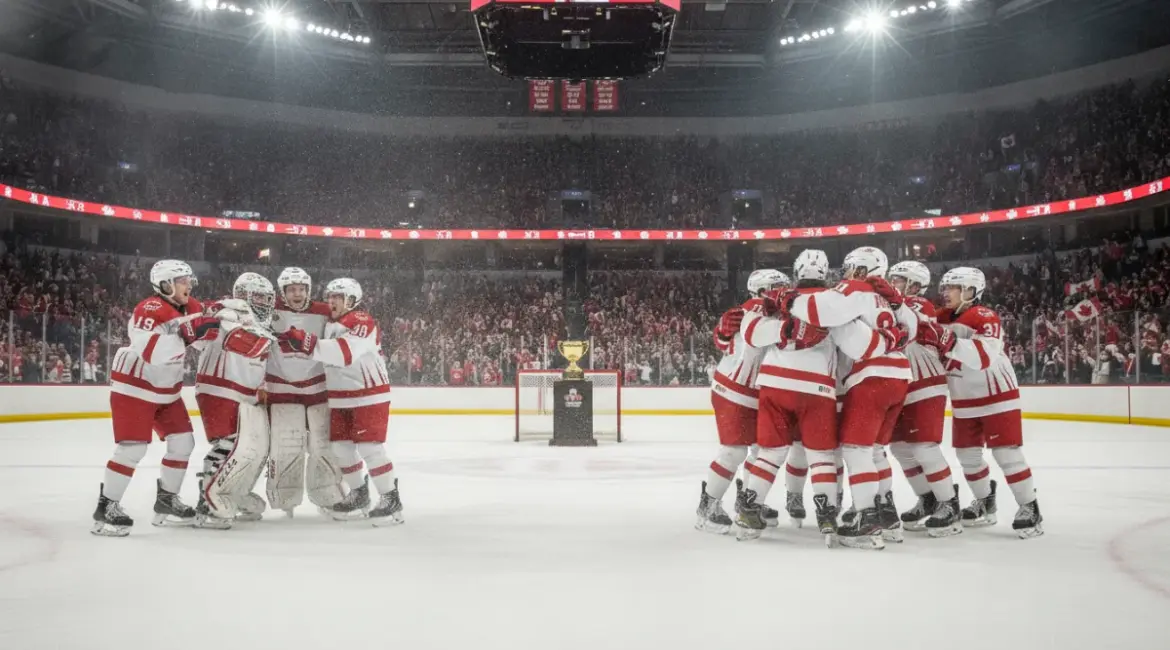
Canada is one win from the championship game after sweeping its preliminary schedule in Edmonton. The next hurdle is Finland, and the reward for advancing is a Saturday showdown with either the United States or Slovakia.
The hosts have looked like a complete team through three games, piling up 20 goals while staying unbeaten. Their semifinal meeting with Finland on Friday at Rogers Place is the first real elimination test of the tournament.
Semifinal Schedule and Final Possibilities
Canada and Finland meet on Friday, August 7, 2026, with puck drop set for 5 p.m. Mountain Time, 7 p.m. Eastern Time, 4 p.m. Pacific Time, 8 p.m. Atlantic Time, and 8:30 p.m. Newfoundland Time. The winner moves on to the gold medal game at Rogers Place, while the loser is sent to the bronze medal game.
The championship game is scheduled for Saturday, August 8, and it will follow the same evening time slot in Edmonton. The bronze medal contest is set for noon Mountain Time earlier that day. TSN and RDS are carrying the games at Rogers Place.
Canada’s possible opponent is already clear. The other semifinal features the United States and Slovakia on Friday at noon Mountain Time, and the winner of that game will face Canada if the Canadians get past Finland.
| Game | Date | Time in Edmonton | What Is at Stake |
|---|---|---|---|
| Canada vs. Finland | Friday, August 7 | 5 p.m. MT | Spot in the final |
| United States vs. Slovakia | Friday, August 7 | Noon MT | Other final berth |
| Gold medal game | Saturday, August 8 | 5 p.m. MT | Tournament title |
| Bronze medal game | Saturday, August 8 | Noon MT | Third place |
How Canada Reached This Point
Canada opened with a 7-3 win over Switzerland, then followed with a 6-1 result against Slovakia to take control of Group A. It finished the round with a 7-4 victory over Sweden, a game that showed both its scoring punch and its ability to keep pushing after early success.
- Against Switzerland, Canada spread the offense around, with Liam Pue and Brock England each scoring twice.
- Against Slovakia, Kayden Stroeder scored twice as Canada locked down first place in the group.
- Against Sweden, the hosts jumped out fast, scored five times in the first period, and added late insurance after Sweden closed the gap.
That run left Canada with three wins, 20 goals for, and eight against. It also confirmed the team as one of the tournament’s top title threats.
Key Names for the Knockout Round
Maddox Schultz has been Canada’s top scorer so far, finishing the preliminary stage with one goal and six assists. He has driven play, created openings, and made life easier for the forwards around him.
Liam Pue leads the team in goals with four, and his ability to finish chances near the crease could matter even more against a disciplined Finnish defense. Kayden Stroeder has matched the pace of the attack with three goals and three assists, giving Canada another forward who can swing a game quickly.
On the blue line, Landon DuPont has been one of the most watched players in the event. He has one goal and two assists, and his puck movement has helped Canada exit its zone cleanly and stay active on the power play. He also brings prior tournament experience after winning bronze with Canada at the 2025 Hlinka Gretzky Cup.
Goaltender Leif Oaten may not see a flood of shots, but he could still face a few high-value chances if Finland turns the game into a tighter, lower-possession contest. Canada’s attack has been the headline, yet a steady night in goal may be just as important in a semifinal.
What Finland Brings Into the Game
Finland earned its place in the semifinal by winning two of three preliminary games. It started with a comeback victory over Germany, stumbled against the United States, and then edged Czechia 5-4 to survive and advance.
Goalie Samu Heikkinen is a major reason Finland remains a threat. He stopped 38 shots against Czechia and entered the semifinal with a .922 save percentage, one of the best marks in the tournament after the preliminary round.
Finland is unlikely to control the game for long stretches, but it does not need to. If it keeps the score close, waits for turnovers, and makes Canada work for every rebound, the pressure shifts quickly.
Canada should expect more possession and more attempts from the outside. The challenge is turning that pressure into goals before Finland can settle into its structure.
What Canada Needs to Do
The path to the final is straightforward, even if the task is not. Canada has to stay disciplined, manage the puck, and keep its attack patient when the first wave of chances is stopped.
It also needs to avoid the kind of lapses that gave Sweden life in the third preliminary game. Penalties opened the door there, and Finland is good enough to capitalize on similar mistakes.
If Canada keeps its pace, uses its depth, and creates traffic around Heikkinen, it should generate enough offense to reach the gold medal game. If it chases quick goals instead of sustained pressure, the semifinal could become far tighter than expected.