
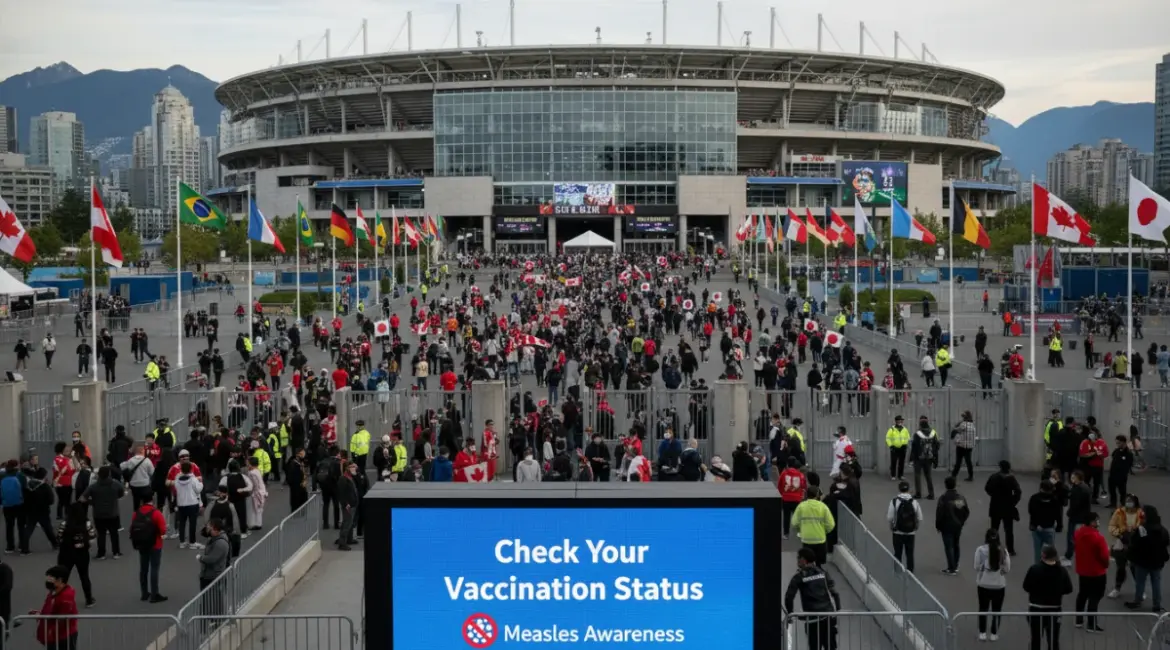
Health officials in Canada are watching the months before the FIFA World Cup in Vancouver closely, and measles is near the top of the concern list. The tournament will draw international travelers, packed crowds, and long stretches of close contact, which creates the kind of environment where a highly contagious virus can move quickly if it gets in.
The Public Health Agency of Canada has already identified measles as one of the most likely diseases to be imported during the event. That concern is not based on speculation alone. Measles is still active in many countries, it spreads through the air with remarkable ease, and major sporting events bring together people from many regions in ways that can make tracing and containment harder.
Ontario has published a public risk assessment that points to the same problem set: international travel, crowded stadiums, and falling vaccination coverage can combine into a serious outbreak risk. British Columbia has completed its own planning, but a public version of that assessment has not yet been released.
Why Officials Are Paying Attention Now
Public health experts say the threat is not that every visitor will arrive with measles. The issue is that just one infected traveler can expose dozens of others before symptoms are recognized. Because measles can linger in the air after an infected person leaves a room, the virus is especially hard to control in airports, hotels, transit hubs, and fan zones.
Dr. Brian Conway, medical director of the Vancouver Infectious Diseases Centre, has argued that the province should be doing more to alert people before the crowds arrive. In his view, residents and visitors need a clear reminder to check their vaccination records and make sure they are protected.
- Measles spreads before many people realize they are sick.
- Large events create more opportunities for exposure.
- Low vaccination rates make containment much harder.
- Importing one case can become a local problem if immunity is uneven.
Conway also says travelers should understand that Canada is already dealing with active measles transmission, which makes prevention more urgent than usual.
The Current Situation Across Canada
Canada has seen more than 900 measles cases this year across seven jurisdictions, with Alberta and Manitoba reporting the largest share. That follows an even larger outbreak last year, when more than 5,000 infections were recorded. Health officials believe that surge began after a case linked to exposure outside Canada appeared in New Brunswick in the fall of 2024.
British Columbia’s numbers are also a reminder that the virus has not faded away. Provincial reporting shows 470 cases across 2025 and 2026, and roughly 80 percent of them were concentrated in northeastern B.C., where immunization rates are among the lowest in the province.
| Location | Reported Measles Activity | What It Suggests |
|---|---|---|
| Canada overall | More than 900 cases this year | Ongoing national transmission risk |
| B.C. | 470 cases in 2025 and 2026 | Importation and local spread remain concerns |
| Northeastern B.C. | About 80% of provincial cases | Lower vaccination coverage leaves some communities more exposed |
What Vancouver Health Leaders Say Is Different This Time
Vancouver Coastal Health says it has been preparing for the World Cup for years and has completed a health risk assessment with the B.C. Centre for Disease Control. While the full findings have not been shared publicly, Deputy Chief Medical Health Officer Dr. Mark Lysyshyn has said the measles risk was rated in the medium, or moderate, range.
That rating does not mean there is no threat. It means the region has to stay ready, but it also reflects a practical advantage: strong local immunization rates have helped stop imported cases from spreading further during the current outbreak. Lysyshyn said the region has already dealt with dozens of imported cases without seeing sustained community spread.
In other words, the system has experience. If a case does appear during the tournament, public health teams are likely to move quickly with testing, contact follow-up, and isolation guidance. The hope is to catch any exposure before it grows into a chain of transmission.
History Offers a Clear Warning
Vancouver has seen this pattern before. After the 2010 Winter Olympic Games, British Columbia recorded a measles outbreak that reached 82 confirmed cases. The circumstances were different, but the lesson remains the same: major international events can create exactly the kind of mobility and congestion that infectious diseases need.
Dr. Monika Naus of the University of British Columbia’s School of Population and Public Health says the broad public risk is still limited because most adults are already immune, either through vaccination or prior infection. Even so, she warns that the danger rises sharply when the virus reaches communities where vaccination coverage is low.
For B.C., that means the greatest concern is not necessarily the average spectator in Vancouver. It is the cluster of communities where immunity is lower and the virus could find room to spread after an imported case arrives.
What Residents and Visitors Should Do
Experts say the most practical step is also the simplest: confirm vaccination status before the first kickoff. Measles is one of the most contagious viruses known, but it is also preventable with routine immunization. Checking records early gives people time to catch up on missed doses before the city fills with tournament traffic.
- Review childhood or adult immunization records.
- Ask a health provider if two doses were received.
- Pay attention to fever, cough, red eyes, and rash after travel.
- Seek medical advice quickly if measles is suspected.
- Help protect infants and others who cannot be fully vaccinated.
Canada also lost its measles elimination status last year, after the Pan American Health Organization determined that transmission was no longer limited to isolated imported cases. That status can be regained only after a full year without ongoing transmission, which shows how persistent the current challenge has become.
As Vancouver prepares for the World Cup, officials are trying to balance excitement with caution. The event will be a major international celebration, but public health specialists want to make sure it does not become a wider opening for a disease that can be stopped with preparation.