
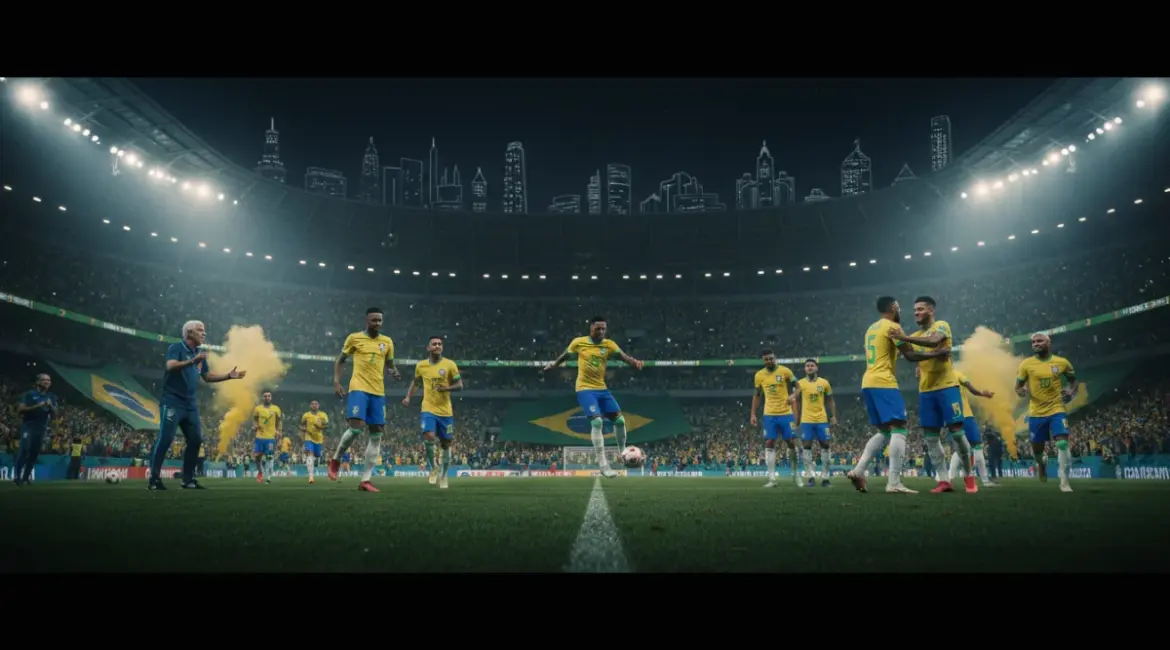
Ancelotti’s first major selection test
Carlo Ancelotti is about to reveal his first World Cup roster as Brazil head coach, and the timing carries real weight. After sending FIFA a broad 55-player pool, he now has to cut that group down to the final 26 who will represent the Seleção in the United States, Canada, and Mexico. For a country still chasing its first world title since 2002, this is more than a routine selection exercise. It is the opening statement of a new era.
The challenge is straightforward to describe but difficult to solve: keep enough experience to handle knockout pressure, preserve enough form to match the best teams in the field, and avoid leaving behind players who can decide matches on their own. Ancelotti’s reputation for calm decisions will be tested immediately.
The spine of the team already looks familiar
Several players appear close to certain places on the final list. Alisson remains the clear first-choice goalkeeper, with Ederson in position to provide high-level support. In front of them, Marquinhos and Gabriel Magalhaes look like the most trusted central defensive pairing, while Casemiro, Bruno Guimaraes, and Lucas Paqueta give Brazil a midfield core built for both control and resilience.
Out wide and up front, the team still has the kind of star power that can change a tournament. Vinicius Junior is expected to be one of the main attacking outlets, with Raphinha, Matheus Cunha, and Gabriel Martinelli also firmly in the mix. At fullback, Wesley seems to have the edge on the right, while Alex Sandro is the likeliest option on the left. That shape points toward a squad that is not being rebuilt from scratch, but rather sharpened around a dependable center.
Injury setbacks have changed the conversation
Brazilians have spent much of the buildup talking about the players who will not make it, and the injury list is significant. Rodrygo’s knee surgery has removed one of the team’s most flexible attackers from the picture. Eder Militao’s ongoing knee issue has also reduced defensive depth, while Estevao Willian’s serious muscle injury has taken away one of the brightest young options before he could even fully enter the tournament picture.
Those absences matter because they do not just weaken the squad; they alter its balance. Without those names, Ancelotti has had to think harder about where creativity comes from, how many defenders he can safely carry, and whether there is room for a veteran who has defined Brazilian football for more than a decade.
The Neymar decision still shapes the final cut
No selection issue has drawn more attention than Neymar. He was placed in the preliminary group despite not having played for Brazil since his serious knee injury against Uruguay in October 2023. At 34, he remains the national team’s all-time leading scorer, and reports from Brazil suggest Ancelotti is leaning toward including him if only because the squad now needs one more player capable of acting as a true difference-maker.
Neymar has also offered his own case by insisting that he feels physically ready and has done everything required to earn his spot. If he is chosen, the most likely player to lose out could be Joao Pedro, whose strong club form still may not be enough to overcome the weight of Neymar’s status and tactical versatility.
Group C offers a manageable path, but not an easy one
Brazil will open in Group C against Morocco, Haiti, and Scotland, a draw that many observers consider favorable compared with the kind of group-stage obstacles that have haunted past campaigns. Morocco is the only opponent in the section regularly discussed as a top-tier challenge, while the other two fixtures should give Brazil a real chance to control its destiny early.
The schedule matters as much as the opponents. Brazil begins against Morocco at MetLife Stadium in East Rutherford, then meets Haiti in Philadelphia before closing against Scotland in Miami Gardens. A strong start would almost certainly put the team in position to finish first and set up a Round of 32 meeting with a third-place finisher from another group.
What the likely starting shape could look like
Based on the friendlies against France and Croatia, Brazil may lean toward either a 4-2-3-1 or a 4-3-3. That would allow Ancelotti to protect the midfield while still leaving enough room for his best attackers to operate in advanced areas. A probable setup would feature Alisson in goal; Wesley, Marquinhos, Gabriel Magalhaes, and Alex Sandro across the back line; Casemiro and Bruno Guimaraes in central midfield; Raphinha, Lucas Paqueta, and Vinicius Junior behind a central striker such as Matheus Cunha or Igor Thiago.
If Neymar earns a place, his presence could change the entire attacking structure. He could slide into the central playmaking role behind the striker, or he could be used in a freer position where his passing range and close control can link midfield with the final third. Either way, his inclusion would make Brazil harder to predict.
Why this squad matters beyond one tournament
This roster is not only about the 2026 World Cup. It is also a measuring stick for Ancelotti’s first months in charge and a preview of how Brazil wants to play for the next cycle. The final list will reveal whether the team is leaning toward veteran certainty, youthful energy, or a careful mix of both.
Brazil arrives in the tournament with one of the deepest pools of attacking talent in world football, a settled midfield, and a defense that still has big names despite the injury losses. If the final choices click early, the Seleção will enter the knockout stage with legitimate belief that the long wait for a sixth title can finally end.