
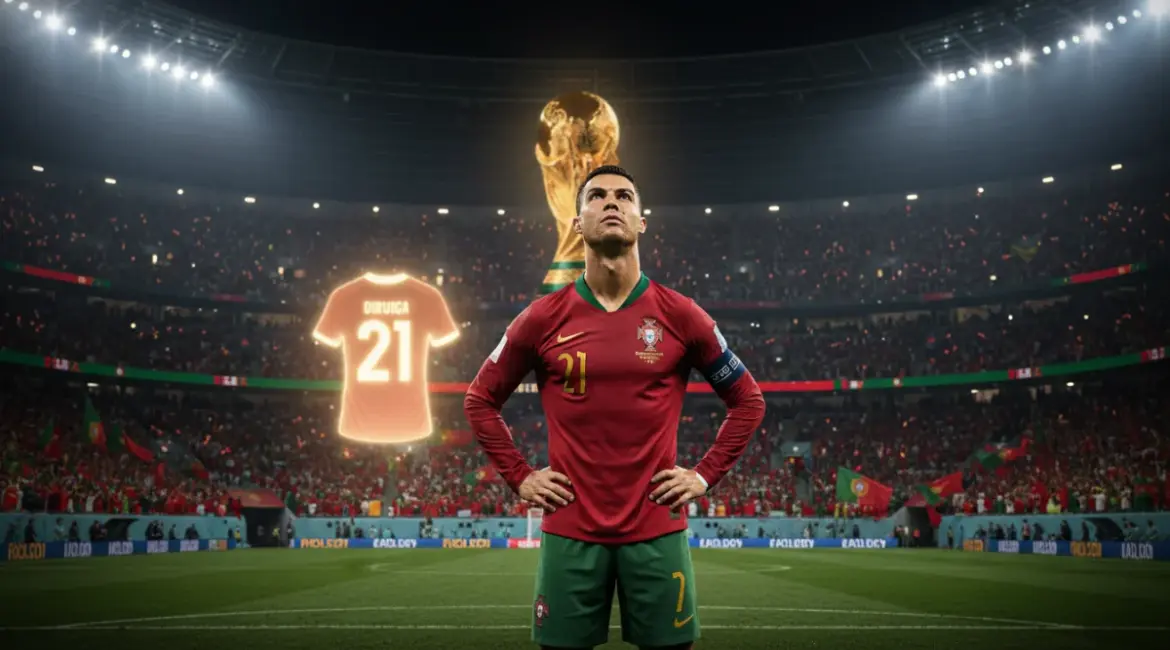
Portugal has revealed its World Cup roster, and the announcement immediately centered on two powerful themes: Cristiano Ronaldo’s pursuit of another historic milestone and a heartfelt tribute to Diogo Jota. The squad mixes experience, versatility, and high-level talent, giving Roberto Martínez a group that looks built to compete deep into the tournament.
Ronaldo remains the most recognizable name on the list, and his possible appearance at a sixth World Cup would add yet another landmark to a career already filled with records. At the same time, Martínez made sure the squad announcement carried emotional weight by honoring Jota, whose memory will travel with the team throughout the competition.
Ronaldo’s Next Shot at History
At 41, Cristiano Ronaldo is still at the center of Portugal’s plans. If he takes the field, he will join a tiny group of men to appear in six different World Cups. That alone would be remarkable, but Ronaldo’s case carries even more significance because he has already rewritten the record books several times over.
He enters the tournament with the most goals in men’s international football, the most caps in the men’s game, and the distinction of being the only male player to score in five separate World Cups. For Portugal, his selection is about more than nostalgia. Martínez continues to value Ronaldo’s leadership, edge, and finishing ability in major moments.
This is also part of a wider narrative in world football, since Lionel Messi could also match the six-World-Cup mark if he appears for Argentina. That possibility gives the tournament an added layer of star power before a ball is even kicked.
Jota’s Memory Shapes the Squad
While Ronaldo drew the biggest headlines, the emotional core of the announcement was Diogo Jota. The former Liverpool and Portugal forward died in a car crash in Spain last year at the age of 28, a loss that shook both his teammates and the wider football community.
Martínez made clear that Portugal will carry Jota’s spirit through the tournament. Although official squads are limited to 26 players, Portugal named 27 in symbolic fashion, treating Jota as the team’s permanent “plus one.” It was a simple gesture, but one with real meaning for a group that wants to honor a fallen teammate by playing with purpose.
How Portugal’s Roster Is Built
Portugal arrives with one of the most complete squads in the competition. The team has depth at goalkeeper, pace and intelligence in defense, creativity in midfield, and a forward line that can hurt opponents in multiple ways. That balance is what makes Portugal so dangerous.
| Unit | Main Strength | Notable Names |
|---|---|---|
| Goalkeepers | Reliability and depth | Diogo Costa, José Sá, Rui Silva, Ricardo Velho |
| Defenders | Physical strength and attacking width | Rúben Dias, João Cancelo, Diogo Dalot, Nuno Mendes |
| Midfielders | Control, passing, and tempo | Bruno Fernandes, Bernardo Silva, Vitinha, João Neves |
| Forwards | Finishing and direct attacking threat | Cristiano Ronaldo, Rafael Leão, João Félix, Gonçalo Ramos |
Goalkeeper Options
Diogo Costa is expected to lead the position, with José Sá and Rui Silva offering experienced cover. Ricardo Velho is included as a fourth option and would likely see action only if injuries forced a change. It is a stable group, and that kind of consistency matters in a tournament setting.
Defensive Balance
Portugal’s back line combines control and aggression. Rúben Dias anchors the unit, while João Cancelo, Diogo Dalot, and Nuno Mendes give the team serious width from fullback. That allows Portugal to attack without losing its shape, a major advantage against top opponents.
Midfield Creativity
The midfield may be Portugal’s strongest area. Bruno Fernandes and Bernardo Silva bring proven quality and vision, while Vitinha and João Neves add energy and calm distribution. Rúben Neves and Samú Costa provide additional options, giving Martínez flexibility depending on the opponent and match state.
Attack and Movement
Portugal can approach games in several ways. Ronaldo can play as the central reference point, Gonçalo Ramos can lead the line in a more modern pressing setup, and wide threats like Rafael Leão, Pedro Neto, and Francisco Conceição can stretch defenses. João Félix and Francisco Trincão add more technical variety, which gives the squad plenty of tactical choices.
Group Stage Road Map
Portugal has been placed in Group K, where it will face Congo, Uzbekistan, and Colombia. The opening match against Congo is scheduled for June 17 in Houston, and the buildup begins much earlier, with the squad gathering on June 1.
- June 6: Portugal vs. Chile
- June 10: Portugal vs. Nigeria
- June 12: Travel to the United States
- June 17: Portugal vs. Congo
Those warm-up matches should help Martínez finalize his structure and test combinations before the tournament pressure begins. The staff will want clarity on roles, especially in midfield and across the front line.
Why Martínez Believes This Team Can Compete
Martínez has avoided labeling Portugal as a favorite, but he clearly believes the team belongs among the contenders. His view is that the “favorite” tag usually belongs to nations with a World Cup title already in hand, and Portugal has not yet crossed that line.
Still, recent results justify confidence. Portugal won the 2025 Nations League by defeating Germany in the semifinals and Spain in the final, a strong reminder that this group can handle pressure and beat elite opposition. That kind of form matters when entering the world’s biggest tournament.
Three things stand out most about Portugal’s case: the squad is deep, the midfield can control matches, and the attack has both speed and finish. Add Rúben Dias at the back and Ronaldo’s leadership up front, and the team has a clear foundation. The emotional drive to honor Jota only adds to that mix.
What This Tournament Means for Portugal
For Ronaldo, this may be the final major World Cup chapter of his international career. For Portugal, it is a chance to turn one of the country’s best generations into a champion side. And for Jota, it is a campaign that will carry memory, pride, and purpose from the first whistle to the last.
Portugal enters with talent, belief, and a clear sense of mission. The squad is good enough to challenge anyone, and the story around it makes the run even more compelling. Ronaldo is chasing history, Martínez is chasing a title, and the team is carrying Jota with them every step of the way.