
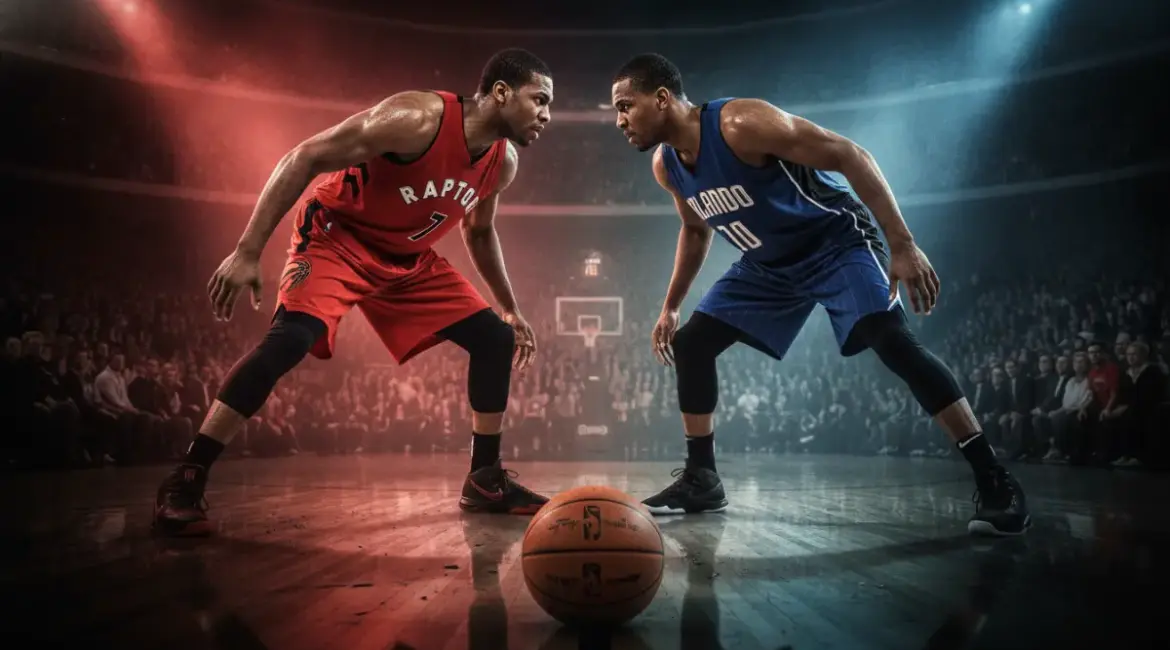
Toronto gets an immediate opportunity to reset when the Raptors host the Orlando Magic at Scotiabank Arena on Wednesday, October 28, 2026. The 7:30 p.m. ET matchup brings together a Toronto team that started 2–1 and an Orlando squad trying to build on its latest road win.
The Raptors opened the campaign with victories over Chicago and Washington before running into trouble against Minnesota. Orlando, meanwhile, lost its first two games but responded by defeating the New York Knicks away from home. With major contributors unavailable on both sides, this Eastern Conference meeting will place unusual pressure on the teams’ supporting casts.
Game Information and Early-Series Context
| Category | Details |
|---|---|
| Matchup | Orlando Magic at Toronto Raptors |
| Date | Wednesday, October 28, 2026 |
| Start time | 7:30 p.m. ET |
| Location | Scotiabank Arena in Toronto |
| Toronto record | 2–1 |
| Orlando record | 1–2 |
| Canadian television | TSN |
| Next meeting | Friday, October 30, in Toronto |
The teams will play again two days later, creating a quick chance for both coaching staffs to study the first contest and alter their plans. Friday’s meeting is scheduled as part of NBA Cup group play, so the opening game could carry strategic importance beyond a single result.
Toronto Must Restore Its Offensive Identity
Toronto looked dominant in its opener, overwhelming Chicago 135–92. The Raptors followed that performance with a 112–102 win against Washington, but their rhythm disappeared in a 117–94 loss to Minnesota.
The Timberwolves made life difficult in the half court and kept Toronto from generating the efficient looks it found earlier in the season. The Raptors were also unable to rely on Scottie Barnes, who finished scoreless in 28 minutes after producing 28 points and 14 rebounds against Washington.
A return to Scotiabank Arena could help Toronto regain its confidence, but home-court energy alone will not solve the team’s problems. The Raptors need sharper passing, quicker decisions and more reliable production from their primary creators.
Barnes Has to Be More Aggressive
Barnes remains Toronto’s most versatile offensive piece. He can initiate possessions, attack mismatches, rebound from the forward position and create opportunities for teammates. Against Minnesota, however, he did not threaten the defense enough to influence the game.
Orlando will likely test him with different coverages and force him to make decisions in traffic. If Barnes attacks early, Toronto can open driving lanes for RJ Barrett and Immanuel Quickley while creating cleaner perimeter chances for younger shooters.
Ja’Kobe Walter also deserves attention after scoring 22 points in the Minnesota game. His ability to make shots from outside could help stretch Orlando’s defense, particularly if the Magic focus on stopping Toronto’s drives.
Orlando’s Confidence Comes With a Major Caveat
The Magic entered the season with losses to Atlanta and Minnesota, yet they showed considerable resilience in New York. Orlando won 111–102 on October 25 despite playing without Paolo Banchero, its leading scorer and one of the team’s central offensive engines.
Franz Wagner led the way with 23 points, 13 rebounds and nine assists, narrowly missing a triple-double. Desmond Bane added 22 points, while Tristan da Silva and Anthony Black supplied important minutes and production.
That performance offered evidence that Orlando can distribute responsibility when its preferred lineup is unavailable. Still, duplicating that level of execution against Toronto will require strong ball movement and dependable outside shooting.
Wagner and Bane Create Different Defensive Problems
Wagner is capable of scoring from multiple areas while also functioning as a playmaker. Toronto must prevent him from turning defensive rebounds into transition attacks and should avoid allowing him to operate comfortably as the game’s primary facilitator.
Bane presents a separate challenge on the perimeter. His shooting can punish late rotations, helping Orlando capitalize whenever the Raptors collapse into the lane. Toronto’s defenders will need to communicate clearly and close out under control rather than surrender open three-point attempts.
Injuries Could Shape Every Tactical Decision
Toronto begins an extended stretch without Kawhi Leonard, who is dealing with swelling in his left knee. Reports indicate that the veteran forward is expected to miss multiple weeks, although imaging did not reveal structural damage and the Raptors plan to reevaluate him after one week.
Nate Bittle is also unavailable for Wednesday’s game because of a foot issue. Leonard’s absence removes a significant two-way presence, leaving Toronto to replace his scoring, defensive versatility and late-game experience through a collective effort.
Orlando has an equally difficult injury list. Banchero is out with a right high-ankle sprain, while Jalen Suggs is sidelined by a right knee problem. Jonathan Isaac is unavailable as well, and additional absences may further reduce the Magic’s frontcourt depth.
Without Banchero and Suggs, Orlando must find enough scoring while preserving the defensive pressure that normally comes from its backcourt. Toronto, meanwhile, will ask Barrett, Quickley and Barnes to absorb more responsibility without allowing the offense to become predictable.
Where the Game May Be Decided
Creation Against Set Defenses
Both teams could struggle when the pace slows. Toronto needs Quickley to organize the offense and keep the ball moving, while Barnes must provide a secondary playmaking outlet. Orlando will look to Wagner to manufacture quality opportunities when its normal lineup is unavailable.
The team that handles half-court possessions more patiently should gain an important advantage. Forced shots and stagnant isolation plays could quickly turn into transition chances for the opponent.
Three-Point Discipline
Orlando’s ability to support Wagner with perimeter shooting could determine whether the Magic keep pace. Bane is particularly dangerous when defenders lose track of him during rotations.
Toronto should make the Magic work inside the arc while still protecting against drive-and-kick passes. On offense, the Raptors need to create open attempts instead of relying exclusively on difficult shots late in the clock.
Control of the Glass
Rebounding may become even more valuable if both teams experience scoring stretches. Toronto cannot afford to give Orlando repeated second chances, especially with its own offensive lineup already missing Leonard.
Barnes and the Raptors’ larger players must finish defensive possessions. Strong work on the glass can also allow Toronto to run before Orlando establishes its half-court defense.
Betting Angles Worth Monitoring
The injury situation makes this game difficult to evaluate through the final score alone. Toronto owns the home-court advantage and has the better record, but Orlando’s win over New York showed that the visitors can remain competitive with key players missing.
Point-spread bettors should wait for confirmed lineups and compare how sportsbooks value Leonard’s absence against Orlando’s losses. A narrow Toronto advantage would reflect the Raptors’ location and available scoring, while a larger number could create additional risk because Orlando has already demonstrated strong road resilience.
The total-points market also deserves caution. Missing stars can reduce offensive efficiency and slow the pace, but weak rotations or hot three-point shooting may produce a faster, higher-scoring game than expected.
Individual markets could center on Barnes, Barrett and Quickley. Barnes may receive more touches after his scoreless showing, Barrett could inherit additional shot attempts, and Quickley may have greater responsibility as a scorer and passer. Any prop evaluation should account for expected minutes, usage and the final injury report.
Prediction: Toronto Has a Narrow Home-Court Edge
Toronto appears to have the stronger path to victory, but the matchup should remain competitive. The Raptors have already shown that they can score in bunches, and playing in front of their home crowd may help them recover from the Minnesota setback.
Orlando’s recent success cannot be dismissed. Wagner is playing with confidence, Bane can change the game from outside, and the Magic have already proved they can compensate for Banchero’s absence with balanced contributions.
The prediction is a Toronto win in a close contest. The Raptors’ outlook will depend on Barnes returning to an assertive role, Quickley controlling the tempo and the team improving its half-court execution. If those elements come together, Toronto should have enough depth to take advantage of home court.
Wednesday’s result will also provide an early preview of the adjustments likely to appear in the rematch on Friday. For Toronto, the immediate objective is clear: turn a disappointing offensive performance into a composed response and carry a steadier identity into the next stage of the season.