
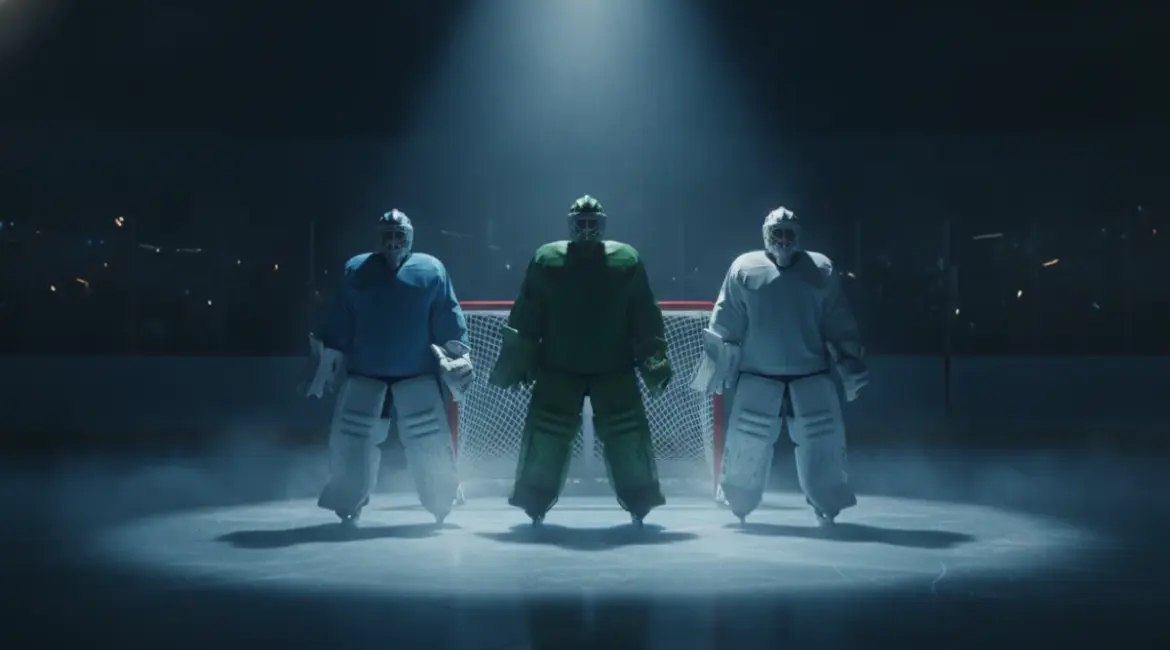
A Crowded Room in Goal
Vancouver’s biggest preseason question may not be about scoring depth or blue-line pairings. It may come down to a far more awkward issue: how the club fits three capable goaltenders into one crease. Thatcher Demko, Kevin Lankinen, and Nikita Tolopilo all bring NHL-caliber arguments to the table, but the roster does not offer enough room for all of them to stay comfortable for long.
That is what makes Tolopilo such a fascinating piece of the puzzle. He is not the established starter, and he is not the veteran safety valve, but he is the one whose place in the organization can shift the most quickly. In a year when Vancouver needs clarity, his situation could force the front office to make a hard choice.
Why Last Season Still Matters
Tolopilo’s 2025-26 campaign was defined by movement, pressure, and uneven results. He split time between the AHL and NHL, taking 19 games in the minors and 21 with Vancouver, which meant he was never allowed to settle into one rhythm for very long. That kind of stop-and-start usage can be difficult for any goaltender, especially one still trying to carve out a permanent role.
The surface numbers were rough. He posted a 3.07 goals-against average and a .897 save percentage in the AHL, then followed that with a 3.61 goals-against average and an .881 save percentage in the NHL. He also had 14 appearances in which he allowed at least three goals, a stat line that shows how often the game tilted against him. Even so, the numbers do not tell the whole story, because there were stretches when he looked capable of handling bigger responsibility.
Games That Changed the Conversation
The most persuasive part of Tolopilo’s season came during a late-January run that gave the Canucks a reason to keep watching. He started three straight games and gave up only four goals in total, even though the team in front of him did not reward that work with much offensive support. Those outings offered a better sample of what he can look like when the structure around him cooperates.
One performance in particular stood out. He stopped 32 shots in a 2-0 win and appeared to have earned his first NHL shutout, only for the result to become a team shutout after he spent 2:11 in concussion protocol and Lankinen had to finish the game. It was the kind of technical footnote that can frustrate a goalie, but it also underscored how sharp he was that night.
He followed that with another strong showing against Toronto on Jan. 31, turning aside 39 shots in a 3-2 shootout loss and even denying Auston Matthews on an overtime penalty shot. For a goalie still trying to prove he belongs, moments like that matter. They travel through the league fast, and front offices remember them when evaluating trade value and depth.
What Vancouver Can Actually Do
The Canucks have three realistic paths, and none of them is especially tidy. The cleanest option is a trade, because Tolopilo has NHL experience and enough recent tape to interest a team looking for help. Vancouver also has reason to value flexibility more than sentiment, especially if the organization believes a younger or more controllable asset would better fit the long-term plan.
Another possibility is the least elegant one: the team simply keeps all three goaltenders. That would give the coaching staff insurance, but it would also create a rotation that can leave everyone a little cold. Goalies generally need regular work, and three-man systems often make that harder to maintain. A club can survive that arrangement for a while, but it is rarely ideal over a full season.
The final scenario is the most interesting one because it would mean a veteran moves instead. Demko and Lankinen are the more established names, but Tolopilo is the one who best matches the age curve of a team still shaping its next phase. That does not guarantee he stays, yet it does make him the easiest goalie to imagine keeping as part of a longer timeline.
What He Must Show at Camp
Training camp will decide much of this. Tolopilo does not need to dominate every scrimmage, but he does need to look steady enough that management believes his 2025-26 season was more about circumstance than ceiling. The organization wants to see sharper rebound control, cleaner tracking through traffic, and the sort of quiet confidence that makes a goalie hard to push aside.
If he delivers that, the payoff can come in two forms. Vancouver could decide that his play makes a veteran expendable, or another team could see enough value to offer something meaningful in return. Either outcome is better than being the third goaltender without a clear path to minutes.
If the Canucks keep him, the challenge becomes patience. He would likely spend much of 2026-27 in a shared role, waiting for starts and trying to make each one count. If he is moved, the workload could climb quickly, especially if he lands with a club searching for a 1A/1B setup. Either way, the next step is less about pedigree and more about opportunity.
The Most Likely 2026-27 Outcome
The safest projection is also the simplest one: Tolopilo stays relevant. He is unlikely to vanish into the background, and he is also unlikely to be risked on waivers for nothing. Vancouver has too much invested in sorting this position out intelligently, and his age makes him a logical part of that conversation.
If he remains in Vancouver, a workload in the range of 30 to 35 starts feels reasonable, with results that probably resemble last season more than a breakout leap. If he is traded, the number of starts could rise into the 40s, depending on the destination and the health of the goalie ahead of him. The exact path is still unsettled, but the stakes are obvious: Tolopilo may end up deciding whether Vancouver keeps its crease crowded or finally clears the traffic.