
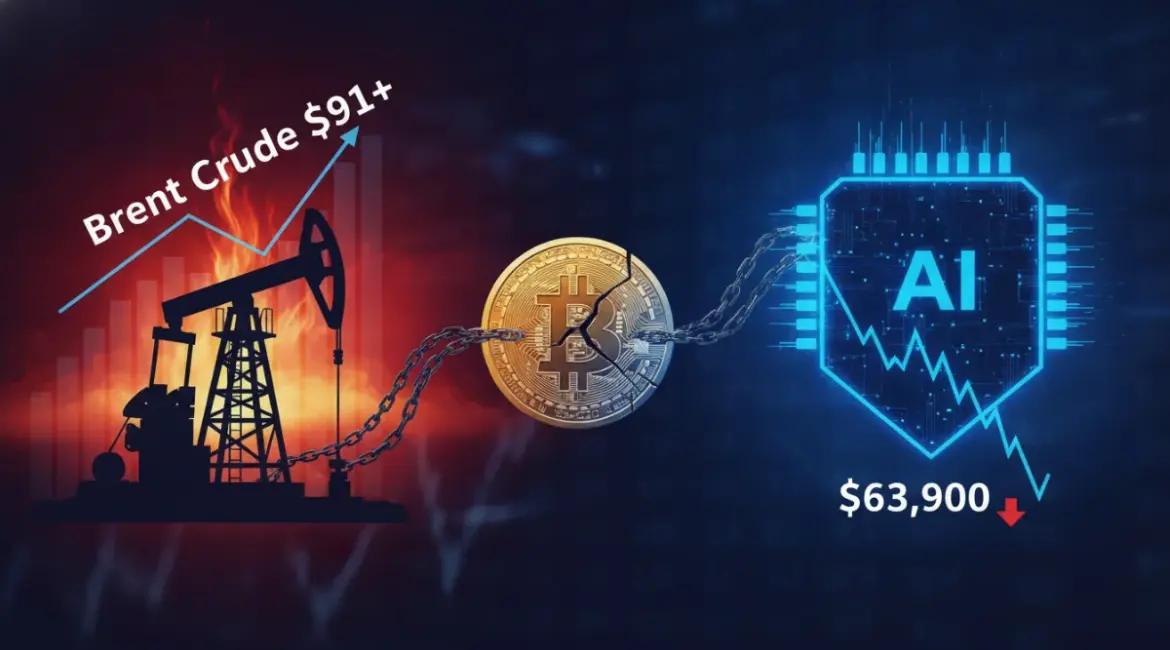
Converging Macro Pressures Trigger Crypto Volatility
The cryptocurrency market is currently navigating a challenging environment where rising energy costs and a technology sector downturn are simultaneously undermining investor confidence. On July 20, 2026, Bitcoin dipped below the critical $64,000 threshold, settling around **$63,900** as it reacted to a “triple headwind” of macroeconomic caution, inconsistent institutional demand, and technical resistance . This decline is not isolated; it reflects a broader shift in risk appetite where capital is fleeing speculative assets amid fears of renewed inflation and sector-specific weakness in the AI industry . The primary catalyst for this downturn is the surge in global oil prices, which has reignited fears of persistent inflation despite recent softer data from the United States. Brent crude oil climbed past **$91 per barrel**, marking its highest level in a month and directly challenging the market’s assumption that inflation is cooling . This energy price spike is a direct consequence of escalating military strikes between the U.S. and Iran, a geopolitical conflict that has disrupted supply expectations and threatened to keep interest rates higher for longer . Historically, when oil prices rise sharply, investors anticipate tighter monetary policy from the Federal Reserve, which typically dampens the appetite for high-risk assets like cryptocurrencies . Parallel to the oil rally, the technology sector is experiencing a significant selloff driven by disappointing earnings and growth projections from major Artificial Intelligence (AI) chip manufacturers, particularly in Asia. The South Korean Kospi index plummeted **3.5%**, signaling a broader retreat from tech-linked investments that has spilled over into the crypto market due to their perceived correlation . Shaurya Malwa, a Crypto Market Analyst at Bullish Inc., explained that Bitcoin’s slide mirrors a “tug-of-war” between inflation anxieties fueled by oil and the uncertainties plaguing the AI sector . Key factors driving the current market downturn include:
- Geopolitical Instability:</ Escalating U.S.-Iran strikes have pushed oil prices to $91/barrel, stoking inflation fears and reducing risk appetite .
- AI Sector Weakness: Disappointing earnings from Asian chipmakers caused a 3.5% drop in South Korea’s Kospi, dragging down tech-linked crypto assets .
- Macro Caution:
- Technical Resistance: Bitcoin faces overhead resistance near the $64.5K–$65.5K zone, preventing a sustained breakout .
Detailed Cryptocurrency Price Performance and Market Data
The impact of these macro forces is evident across the entire digital asset spectrum. While Bitcoin leads the decline, other major cryptocurrencies are also experiencing downward pressure, though with varying degrees of severity. The market is currently displaying a fragile stabilization that could break in either direction, but the immediate trend remains structurally bearish on the daily timeframe . The following table outlines the specific price performance of key assets as of July 20, 2026, highlighting the widespread nature of the selloff:
| Cryptocurrency | Price (July 20, 2026) | 24h Change | Weekly Change |
|---|---|---|---|
| Bitcoin (BTC) | $63,900 | -1.3% | +2.0% |
| Ethereum (ETH) | $1,850 | -1.1% | — |
| Binance Coin (BNB) | $564 | -0.8% | — |
| XRP | $1.09 | – | — |
| Dogecoin (DOGE) | — (down 1.4%) | -1.4% | — |
| Hyperliquid’s HYPE | $60 | — | -8.0% |
Ethereum softened by **1.1%**, falling to **$1,850**, while Binance Coin and XRP also saw modest declines, reinforcing the notion of a broad market correction . Notably, Hyperliquid’s HYPE token has emerged as a significant underperformer, suffering an **8% weekly loss**, which indicates severe volatility within specific niche sectors of the crypto ecosystem . This sector-specific weakness suggests that while the broader market is reacting to macro headlines, individual projects are facing their own internal liquidity challenges. Dr. Linda Chen, an economist from the Global Economic Forum, noted that inflationary concerns stemming from geopolitical conflicts typically prompt investors to shift away from riskier assets, driving price corrections across the board . The correlation between the AI chip selloff and crypto movements is not direct but is driven by sentiment; investors are recalibrating their exposure to technology innovation, including blockchain and crypto assets, as a result of the broader tech downturn .
Bitcoin ETF Flows and Future Market Outlook
Despite the turbulent price action, institutional channels have shown faint signs of resilience. Bitcoin ETFs have recorded small inflows recently, suggesting that some long-term investors view the current dip as a value opportunity. However, these inflows are described as “peanuts” relative to the massive exodus seen in prior weeks, indicating that institutional confidence remains fragile amid ongoing macroeconomic uncertainties . The sustained selling pressure from U.S. spot Bitcoin ETFs has been a primary driver of Bitcoin’s decline in 2026, contributing to a supply overhang that has weighed heavily on prices . Looking ahead, the market outlook remains uncertain until clear signals emerge regarding inflation trends and the stability of the technology sector. Analyst expectations vary from cautious consolidation to a gradual recovery, contingent on positive macro developments. If the mid-July inflation report comes in cooler and ETF money begins flowing back in, Bitcoin could hold above **$60,000** and turn it into support . However, if the Federal Reserve maintains a hawkish stance, the price could chop between **$56,000 and $62,000** with a downward tilt . Critical support levels to watch include the daily S1 level at **$62,565** and the more critical floor at the Bollinger lower band of **$58,359** . If current support fails, the worst-case scenario for Bitcoin’s price in the near future is a drop to **$40,000** before the next crypto bull rally begins . Investors should remain vigilant regarding geopolitical developments in the Middle East, upcoming inflation data, and trends in the AI technology sector, as these factors will likely dictate crypto market trajectories in the immediate future . Volatility is inherent to cryptocurrencies, especially during periods of macroeconomic stress, and investors should avoid overexposure to mitigate potential risks .