
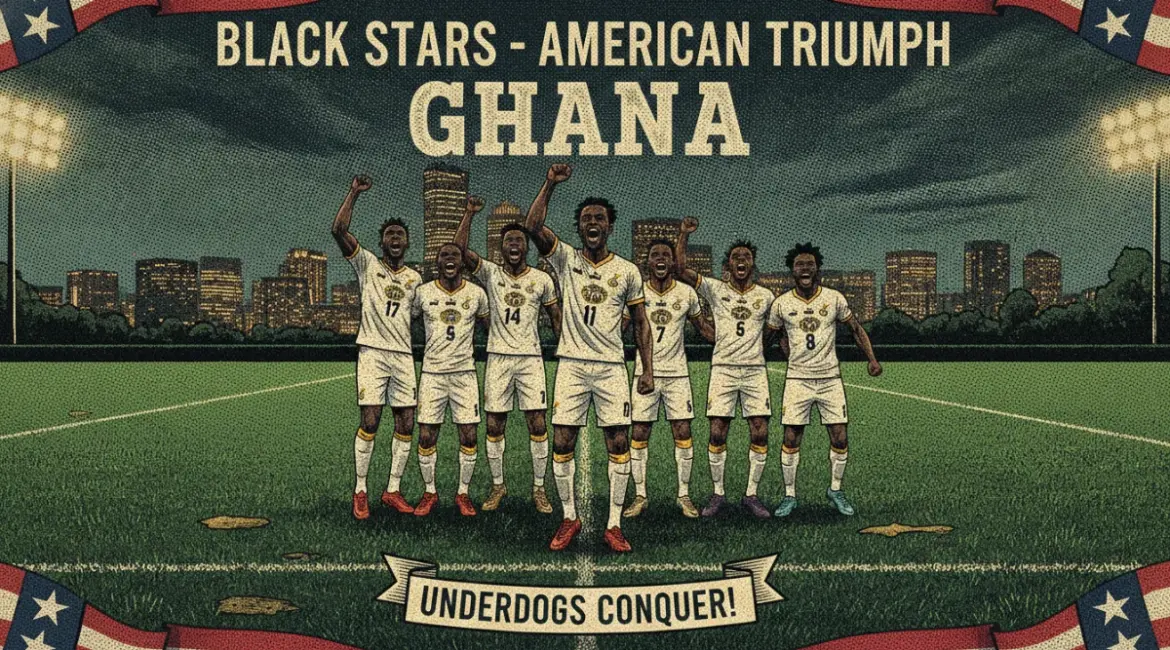
In a match that defied all expectations, Ghana held tournament powerhouse England to a 0-0 draw in Boston, proving that tactical discipline can overcome even the most overwhelming attacking talent. The result has turned Group L into a exciting four-way battle, with both teams now sitting at the top with four points each.
The silence that settled over Boston Stadium on June 23, 2026, was not the quiet of a boring game, but the heavy, suffocating silence of England’s frustration. Despite controlling 72% of the possession and firing 19 shots at goal, England could not find a single breakthrough against a Ghana defense that refused to crack. It was a 0-0 that felt like a victory for Ghana and a crushing defeat for England’s hopes.
Ghana, the 73rd-ranked team in the world, walked off the pitch after denying England—the favorites who had just destroyed Croatia by four goals—a single scoring opportunity across 90 minutes. While the official record calls it a draw, for Ghana, this is a monumental statement of their ability to compete with the world’s elite.
How Did Ghana Neutralize England’s Attack?
England entered this match with flying colors, buoyed by their stunning 4-2 victory over Croatia where Jude Bellingham orchestrated the midfield and Harry Kane scored. The narrative was clear: the Three Lions were ready to dominate the 2026 World Cup. However, coach Carlos Queiroz saw a different opportunity.
Ghana, who had scraped past Panama in their opener with a chaotic 95th-minute winner from Caleb Yirenkyi, were considered the underdogs. Nobody expected them to challenge England’s knockout round prospects. Yet, Queiroz had a precise plan:
- Ghana shifted into a compact 4-5-1 defensive shape without the ball.
- Players like Antoine Semenyo and Thomas-Asante dropped into the midfield to block passing lanes.
- The team suffocated England’s build-up play, forcing them into wide areas with no central penetration.
- The trap was set before the first kick of the match, and England walked straight into it.
England’s inability to break through the low block was evident. They dominated possession but created little of note. Thomas Tuchel’s side struggled for extended periods, only threatening late in the second half. Nico O’Reilly hit the crossbar, and Marc Guehi had a header cleared off the line in stoppage time. But the most heartbreaking moment came from Harry Kane himself, who skied a close-range volley with the goal gaping open—a miss that will haunt England fans for days.
The Incredible Shot Statistics
The numbers from this match tell a story of pure frustration for England. While they dominated possession at 72%, they fired 19 attempts at goal with zero on target. Ghana, by contrast, managed just 2 shots, neither of which reached the target. On paper, this looks like a comprehensive England performance. In reality, it was a prolonged exercise in futility.
England’s best chance came late in the game, but the goalkeeper Benjamin Asare kept a clean sheet with 3 crucial saves. The low block held firm, and the Black Stars did not crack under the pressure. This was a tactical masterclass that turned England’s attacking dominance into a nightmare of wasted opportunities.
Carlos Queiroz: The Man Behind the Masterclass
When Carlos Queiroz was appointed Ghana’s coach just months before the tournament, many Ghanaian fans were nervous about his conservative, defensive approach. His reputation for caution preceded him, and questions arose about whether he could lead an attacking team like Ghana. Against England, however, that conservatism became a superpower.
Ghana’s gameplan was clear: sit deep and wait for counter-attack opportunities. When asked if facing England was daunting, Queiroz responded with philosophical confidence: “This is the easiest type of match because when you’re about to play against England, France or Germany, you don’t need to say anything to the players. They’re fully motivated.” This is the toughest type of match for the opponent, as the pressure is entirely on the heavyweight.
Queiroz’s tactical genius was combined with beautiful simplicity. He organized his team to outwit a better-resourced opponent, proving that organization can triumph over chaos. The result was a draw that will be remembered as one of Ghana’s greatest achievements in World Cup history.
Caleb Yirenkyi: The Young Heart of Ghana
One of the sub-plots of Ghana’s tournament has been the emergence of 20-year-old Caleb Yirenkyi, the midfielder who scored the dramatic winner against Panama in the 95th minute. He plays for FC Nordsjælland in Denmark, where he has been coached by Michael Essien, and comparisons to the Ghana legend are being made freely. Yirenkyi is powerful, dynamic, and determined to drive through the midfield.
Against England, Yirenkyi operated on a yellow card tightrope after an early booking, but he never buckled. He is the heartbeat of this Ghana side, and his performance against England showed that he is already ready for the biggest stage. Yirenkyi’s performance against England was a testament to his growing maturity and resilience.
What the Draw Means for Group L
The 0-0 result has created a tense four-way battle in Group L heading into the final matchday. Both England and Ghana now sit at the top with four points, while Croatia and Panama have played only one match each and sit at zero points.
The full picture of the group standings is as follows:
- England: 2 matches, 1 win, 1 draw, 0 losses, 4 points
- Ghana: 2 matches, 1 win, 1 draw, 0 losses, 4 points
- Croatia: 1 match, 0 wins, 0 draws, 1 loss, 0 points
- Panama: 1 match, 0 wins, 0 draws, 1 loss, 0 points
If Croatia defeats Panama, they will climb to three points and set up a final-day showdown with Ghana that will decide who advances to the knockout rounds. Suddenly, the last group game feels enormous. The standings are now incredibly tight, with every point crucial.
Ghana’s Next Challenge: Croatia in Philadelphia
Ghana faces Croatia in Philadelphia on June 27, a match that could define their entire campaign. A win would almost certainly secure their spot in the knockout rounds, while a loss could make things very complicated. For Ghana, the stakes are personal: a victory over Croatia would confirm their spot in the knockouts for the first time since their memorable quarterfinal run at the 2010 World Cup in South Africa.
The 2010 tournament is remembered forever for Luis Suárez’s handball and the heartbreak that followed. Black Stars fans have been waiting 16 years for this moment. The next match is crucial for Ghana’s World Cup dreams.
Croatia, meanwhile, are a wounded animal with World Cup pedigree and nothing to lose. The chess match Queiroz faces in Philadelphia will be his biggest test yet.
Africa’s Quiet Contender: The Bigger Picture
Ghana arrived in America under the radar, missing key players like Mohammed Kudus and facing injury concerns with Lawrence Ati-Zigi. Even Thomas Partey had off-field complications overshadowing his involvement. Yet, here they are: unbeaten, with four points, sitting joint-top of their group alongside England.
With just a point from their remaining game, the Black Stars would almost certainly reach their first knockout round in over a decade. A win, and they go through in style. This result is a huge achievement for Ghana’s World Cup campaign.
The Black Stars have always carried a certain electricity—the drama of 2010, the heartbreak, the personality. This 2026 squad may lack the celebrity of those earlier generations, but they’ve rediscovered something arguably more valuable: collective discipline, belief, and a coach willing to bet on organization over chaos.
England looked at Ghana across that Boston pitch for 90 minutes and couldn’t find a way through. If you’re Croatia, that’s not a comforting thought. The Black Stars are very much alive—and Philadelphia awaits.