
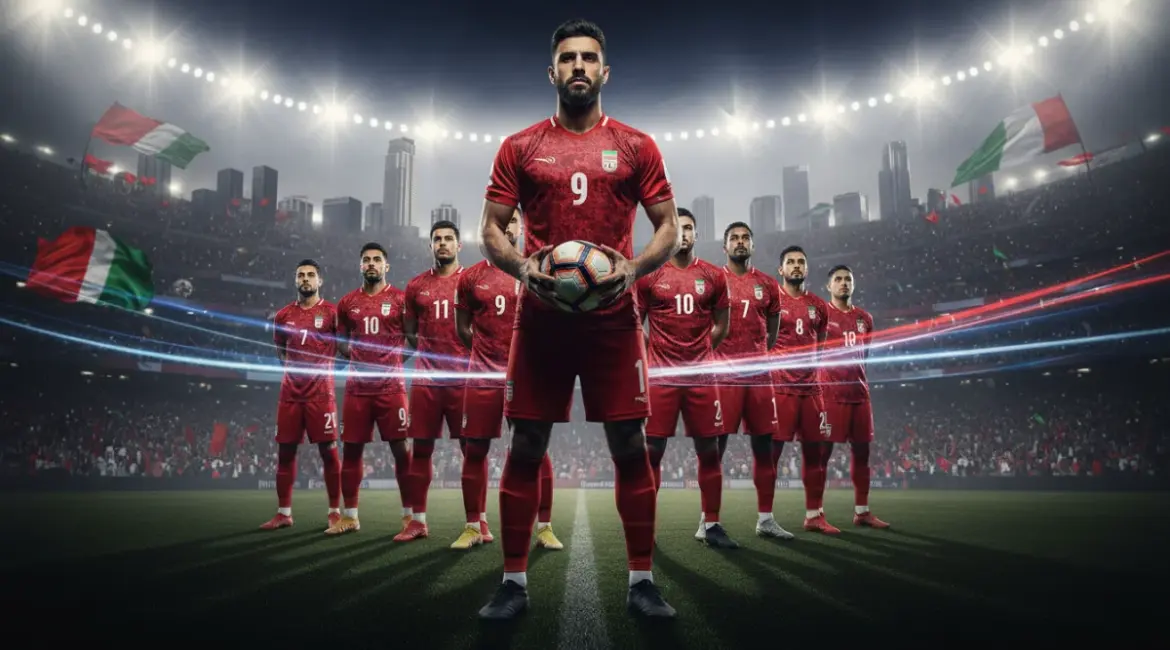
Iran arrives at the 2026 FIFA World Cup with momentum, continuity, and a real chance to change a long-running story line. Team Melli has qualified for a fourth straight tournament and enters the expanded field with veteran leadership, a familiar core, and a group draw that gives supporters genuine hope.
The biggest pre-tournament storyline has been off the field rather than on it. Visa complications involving the United States complicated planning for Iran’s delegation, but the team remains in the competition and has adjusted its base accordingly. That keeps the focus where it belongs: on the matches, the opponents, and Iran’s best path out of the group.
Why Iran’s Participation Drew Attention
Iran’s place at the finals was never in doubt, but its logistics became a major talking point. The team had been expected to prepare in the United States, then shifted to a camp in Turkey while final arrangements were worked out. FIFA approved a plan for Iran to stay in Tijuana, Mexico, and travel for games, which avoids the most difficult travel issues while preserving the schedule.
That setup matters because Iran’s matches are still set to be played in the United States. The border-city base gives the squad a practical training environment and a manageable route to its venues. In short, the off-field uncertainty has been reduced enough for the team to settle into its football plans.
Group G and the Size of the Opportunity
Iran was drawn into Group G with Belgium, Egypt, and New Zealand. On paper, that is a demanding but not overwhelming group, and it offers more than one realistic route into the knockout stage.
- Belgium bring the strongest overall pedigree and the most individual quality.
- Egypt add physical strength, tournament experience, and a disciplined style.
- New Zealand look like the most attainable source of three points.
For Iran, the key is balance. A win in the opener would change the tone of the entire campaign, while a result against one of the heavierweights could make qualification surprisingly attainable. In the new 48-team format, even a third-place finish may keep the door open.
Iran’s Group Stage Fixtures
The schedule gives Iran a useful rhythm, with two matches in Los Angeles and one in Seattle. That concentration on the West Coast could help the team settle quickly and limit disruption between games.
- Iran vs New Zealand — June 15, Los Angeles
- Iran vs Belgium — June 21, Los Angeles
- Iran vs Egypt — June 26, Seattle
The opener against New Zealand is the clearest target for points. Belgium represent the toughest assignment in the group, while the final match against Egypt may well decide whether Iran advances. If the first two games go well, the closing fixture could become a high-stakes battle for placement rather than survival.
Leadership, Structure, and the Core Squad
Iran is guided by Amir Ghalenoei, who returned to the national team in 2023 and helped steer a strong qualifying run. His side lost only once in AFC qualifying and finished comfortably at the top of its group, which reinforced the idea that Iran is not arriving as an underdog in the usual sense.
The attack centers on captain Mehdi Taremi, whose goal record and European experience make him the team’s most important player. Around him are several established names, including Saman Ghoddos in midfield and Alireza Beiranvand in goal. The roster blends overseas experience with players rooted in the domestic league, giving Ghalenoei a team that knows its shape and understands its roles.
What Iran must do well
- Stay compact defensively against Belgium and Egypt.
- Use Taremi’s movement to create chances in transition.
- Turn the New Zealand match into a fast start, not a cautious one.
- Keep possession simple and avoid unnecessary turnovers in midfield.
That formula is not flashy, but it fits Iran’s strengths. The team has traditionally been difficult to break down, and its best performances usually come when the game remains controlled and the defensive structure holds.
What a Breakthrough Would Mean
Iran has made repeated World Cup appearances without ever reaching the knockout rounds. That history adds pressure, but it also adds motivation. This squad has enough experience to know that one strong result can reshape a group, and one poor result can leave little margin for recovery.
For supporters, the hope is simple: convert stability into progress. Iran has the organization to frustrate stronger opponents and the attacking quality to punish mistakes, especially if the opener goes in its favor. The group is difficult, but it is also one of the more navigable paths Iran has had in recent memory.
Fans following the broader tournament can track official updates through the FIFA World Cup site.

What to Watch Once the Matches Begin
If Iran starts well, the team could quickly become one of the more interesting stories in the tournament. A disciplined defense, a sharp counterattack, and a reliable finish from Taremi would give them a realistic chance to push beyond the group stage for the first time.
If the early games turn messy, however, the challenge becomes much harder. Group-stage football often rewards teams that begin decisively, and Iran’s margin for error will shrink with every missed chance. That is why the first match carries so much weight: it is not just a game, but a tone-setter for everything that follows.