
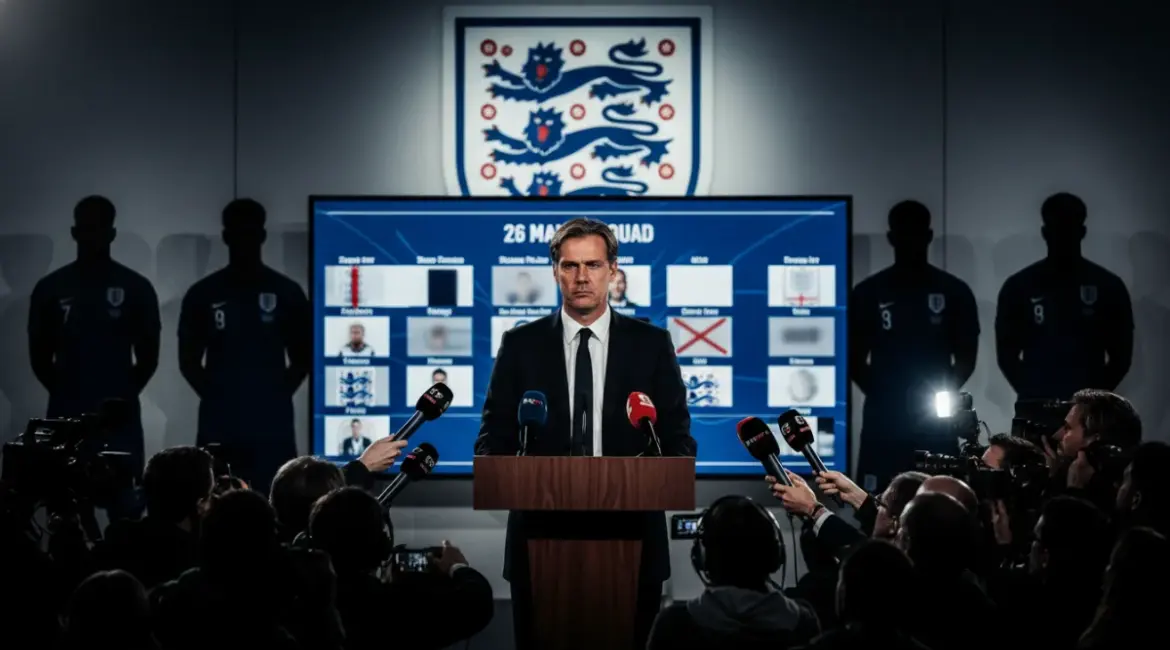
Thomas Tuchel has opened a new and very public chapter in England’s World Cup build-up, and he did it by leaving out several names that many fans expected to see on the plane. His 26-man squad for the tournament in North America immediately sparked debate, not just because of who made the cut, but because of who did not.
Tuchel made it clear from the start that sentiment would not shape his thinking. He wanted difficult calls, and he got them. The announcement, delivered on Friday, showed a manager willing to trust recent camp form, tactical balance, and squad chemistry over reputation alone.
The biggest shocks in the group
The most eye-catching omissions are Cole Palmer, Phil Foden, Trent Alexander-Arnold, and Harry Maguire. Each of them has spent long stretches in the England conversation, and each would have seemed close to a guaranteed place not long ago. Their absence gives this squad a far more surprising look than most expected.
Palmer and Foden, in particular, will draw the most discussion. Both had uneven club seasons, and Tuchel appears to have taken a hard look at how many attacking players he could realistically carry. With so many options in advanced areas, some talented names were always likely to be squeezed out.
Alexander-Arnold’s exclusion feels less shocking than it would have in past cycles, but it still carries weight. The Real Madrid right back has not added to his England total since last summer, and his recent lack of involvement with the national setup left him short on momentum. Maguire, meanwhile, responded with obvious disappointment, saying on social media that he was stunned and devastated to miss out.
Who stepped in instead
While the omissions dominated the headlines, several selections stood out for the opposite reason. Ivan Toney, now with Al-Ahli in Saudi Arabia, earned a notable recall and gives England a different kind of forward option alongside captain Harry Kane. His inclusion suggests Tuchel still values variety in the final third, especially when games become tight and directness matters.
The squad also reflects a clear effort to keep younger and less established players in the mix. Djed Spence, Kobbie Mainoo, Eberechi Eze, Noni Madueke, Jarell Quansah, and John Stones all remain part of the traveling group. That blend of experience and youth is central to what Tuchel seems to be building: a side that can adapt without losing its core identity.
How Tuchel framed the decisions
Tuchel did not pretend the process was easy. He described the conversations with players who missed out as painful and said he had personally spoken with everyone involved in camp at least once. His comments suggested that several of the players left behind were unfortunate rather than overlooked, which only adds to the sense that this was a close selection rather than a simple one.
The manager also pointed back to the international windows in September, October, and November, when England looked more settled and competitive. Those camps appear to have carried real weight in his thinking. Rather than tear everything up, he leaned toward continuity and rewarded the group that had already shown strong balance across the pitch.
Balance was a recurring theme in his explanation. Tuchel made it clear he did not want to load the squad with too many players who fill the same role, especially if that would force others into uncomfortable positions. In his view, a World Cup squad has to work as a functional unit, not just as a collection of talented names.
More players left disappointed
Beyond the four headline absentees, several other players with strong cases were also left out. Morgan Gibbs-White, Adam Wharton, Lewis Hall, Luke Shaw, and Jarrod Bowen were among the names not included, underscoring just how competitive the final decisions were. The result is a squad that feels daring, but also carefully shaped around Tuchel’s preferred structure.
The full 26-man England squad
Goalkeepers: Jordan Pickford, Dean Henderson, and James Trafford.
Defenders: Reece James, Ezri Konsa, Jarell Quansah, John Stones, Marc Guehi, Dan Burn, Nico O’Reilly, Djed Spence, and Tino Livramento.
Midfielders: Declan Rice, Elliot Anderson, Kobbie Mainoo, Jordan Henderson, Morgan Rogers, Jude Bellingham, and Eberechi Eze.
Forwards: Harry Kane, Ivan Toney, Ollie Watkins, Bukayo Saka, Marcus Rashford, Anthony Gordon, and Noni Madueke.
A high-risk bet on familiarity
This squad will not silence debate anytime soon. If anything, it invites more of it. Tuchel has tied his selection to the idea that familiarity, trust, and a stable tactical shape will matter more than late-season headlines or long-standing reputations.
That is a clear gamble, but it is also a recognizable one. England have often been strongest when the group knows itself well and the roles are defined. Tuchel is betting that the players who carried the team through the autumn can do it again when the pressure rises in North America.
Whether that decision looks brave or reckless will depend on the tournament itself. For now, Tuchel has made one thing certain: England are heading to the World Cup with a squad that reflects his ideas, his standards, and his willingness to leave big names behind.